
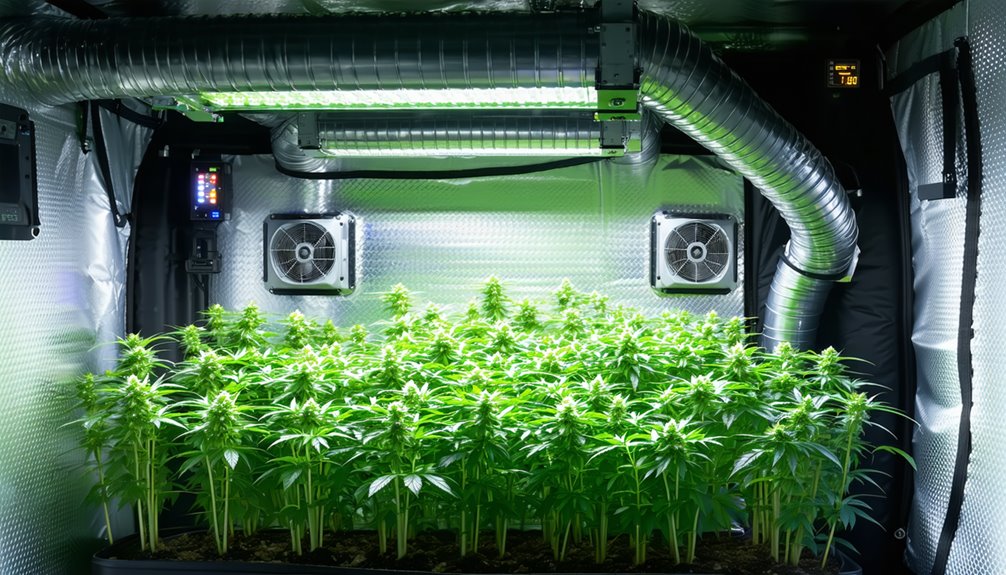
Optimizing Airflow & Ventilation in Gorilla Grow Tent
To optimize airflow and ventilation in your Gorilla grow tent, start by maintaining filters and using high CFM inline duct fans, ensuring exhaust fans exceed intake ones for negative pressure. Position intake vents low and exhaust at the top to effectively manage temperature and humidity. Utilize oscillating fans for even air distribution, and consider smart automation systems for real-time climate adjustments. You’ll find helpful insights on advanced techniques to enhance your grow tent’s environment as you explore further.

Key Takeaways
- Maintain ultra-activated coconut carbon filters for effective odor control and air purification within the grow tent.
- Position intake vents at the base and exhaust systems at the top to promote efficient air circulation.
- Ensure exhaust fans exceed intake fans in CFM to maintain negative pressure and consistent air replacement.
- Use oscillating clip-on fans for targeted airflow, preventing moisture buildup around plants.
- Implement automated monitoring systems to adjust ventilation based on real-time humidity and temperature conditions.
Essential Components for Effective Airflow
 To guarantee ideal airflow in your Gorilla Grow Tent, you need to focus on a few essential components that work together seamlessly.
Start with proper filter maintenance; using ultra-activated coconut carbon filters guarantees excellent odor control and air purification. Position these filters strategically between the intake and exhaust systems for maximum efficiency. The Gorilla Tactical Carbon Filters utilize ultra-activated coconut carbon, which is especially effective at eliminating pathogens and odors.
Next, consider fan placement. High CFM inline duct fans should be stronger than your intake fans to maintain negative pressure, allowing fresh air to flow in effortlessly. This is crucial for effective ventilation as it combats stale air accumulation and regulates humidity levels.
Pair these with clip-on fans for targeted air circulation, addressing stagnant areas and preventing moisture buildup.
Don’t forget about adjustable rope hangers for easy positioning of your equipment, guaranteeing everything is set at the right height for peak performance.
CFM Recommendations for Different Tent Sizes
Understanding the appropriate CFM (Cubic Feet per Minute) for your Gorilla Grow Tent is essential for maintaining ideal airflow and plant health. Start with CFM calculations based on your tent dimensions; for instance, a 4’×4′ tent typically needs 250–350 CFM, so a 6″ fan is recommended. For a 3’×3′ tent, aim for a minimum of 108 CFM. Additionally, the high CFM kit is designed to support exhaust fans with high CFM ratings without compromising grow space. Larger tents, like 8’×8′, require CFM proportional to their volume, making fan selection vital. Proper ventilation is key to temperature control and maintaining a stable growing environment. Don’t forget to apply airflow adjustments: increase CFM by 25% for carbon filters, 10-20% for ducting, and up to 50% for lighting. It’s wise to use a fan that operates at 80% of its max capacity for longevity.
Common Ventilation Configurations for Optimal Performance
 While optimizing airflow in your Gorilla Grow Tent, choosing the right ventilation configuration is vital for plant health and growth.
Start by positioning your intake vents at the base to draw in fresh, cool air, and install your exhaust system at the top with a carbon filter to manage heat and humidity. Proper ventilation impacts plant safety and is essential for indoor cultivation success, so ensuring adequate airflow is crucial. Effective ventilation techniques can further enhance the growth environment by preventing overheating and maintaining optimal humidity levels.
Proper fan placement is essential; use oscillating fans to guarantee even air distribution and direct airflow toward the plant canopy to avoid hot spots.
Consider negative pressure systems where your exhaust fan exceeds intake, promoting consistent air replacement and minimizing pest ingress. Additionally, smart programmable systems can help you maintain ideal humidity control by automatically adjusting based on real-time conditions.
Intake and Exhaust Pressure Management Strategies
Effective intake and exhaust pressure management is essential for maintaining a healthy environment in your Gorilla Grow Tent. By ensuring your exhaust fan’s strength exceeds that of your intake, you create negative pressure that allows filtered air to exit properly. Positioning your intake fans near the tent’s base helps draw cooler air upward, promoting effective airflow balancing. To optimize your setup, use adjustable fan speeds to fine-tune performance without replacing equipment. Make sure your exhaust CFM surpasses intake CFM; for example, aim for 400 CFM exhaust to 300 CFM intake. Additionally, consider multiple intake points for better cross-ventilation, while sealing non-ventilation ports to prevent pests from entering. Regularly monitor humidity and temperature to adapt fan speeds accordingly, ensuring your plants thrive in a well-ventilated environment. Properly functioning grow tent exhaust fans are vital for controlling heat and humidity levels effectively. Understanding pressure dynamics is crucial in improving ventilation strategies and maintaining proper pressure balance for plant health and growth.
Advanced Techniques for Automated Climate Control
 Maintaining ideal airflow is just one piece of the puzzle when it comes to creating the perfect environment in your Gorilla Grow Tent. To truly excel, consider integrating automated monitoring systems like IoT-enabled controllers. These allow you to make smart adjustments effortlessly by connecting multiple sensors for temperature, humidity, and CO₂, all controlled through user-friendly mobile apps. You can optimize airflow with variable speed EC inline fans that adjust based on real-time feedback, reducing energy waste while maintaining a peaceful atmosphere. Additionally, consider using integrated controls that enable remote access to your grow tent climate, making adjustments even more convenient. Effective air movement is crucial for preventing stale air and ensuring that plants receive the CO2 they need to thrive. Multi-zone environmental controls help you manage specific parameters without conflicts. Plus, pre-configured automation profiles streamline your setup for different growth stages. Don’t forget about remote monitoring—set up alerts for any deviations, ensuring you can intervene quickly.
Frequently Asked Questions
How Often Should I Change My Carbon Filter?
You should change your carbon filter every 12 to 18 months, depending on your environment and usage.
Keeping a filter maintenance schedule helps guarantee your air quality stays ideal. Regularly checking the filter’s performance can also guide you on when it’s time for a replacement.
This way, you’re not just serving your own needs but also creating a healthier atmosphere for those around you.
Don’t overlook this essential part of your setup!
Can I Use a Window Fan for My Grow Tent?
You might think a window fan’s enough for your grow tent, but it often lacks the fan efficiency you need.
Instead, consider dedicated exhaust fans that match your tent placement. Selecting fans with higher CFM guarantees better airflow, which is essential for healthy plants.
While window fans can save some energy, they don’t provide the performance required for peak ventilation, potentially compromising your plants’ growth and overall health.
What Size Ducting Is Best for My Tent?
To find the best ducting size for your tent, consider your tent dimensions and the fan’s CFM rating.
For smaller tents like 4×4, 6-inch ducting typically works well, while larger tents, such as 10×10, benefit from 10-inch ducting for ideal airflow.
Make certain that the ducting size matches the fan outlet to prevent pressure build-up.
How Do I Prevent Mold in My Grow Tent?
To keep mold at bay in your grow tent, think of it as a battle against a sneaky foe.
You’ll want to focus on humidity control by maintaining levels between 40-50%.
Install quality fans for proper airflow and avoid overcrowding your plants.
Regularly clean surfaces, ensuring they’re free from debris that could harbor mold.
Is It Necessary to Use a Dehumidifier?
Yes, using a dehumidifier is essential for effective humidity control in your grow space.
It helps prevent mold and pests by managing moisture levels, ensuring your plants thrive.
With a dehumidifier, you can maintain ideal humidity, promoting healthy plant growth and nutrient absorption.
Plus, it minimizes risks during critical flowering phases.
Conclusion
In the world of gorilla grow tents, optimizing airflow and ventilation is like fine-tuning an orchestra; every component must play harmoniously together. By understanding essential elements, CFM needs, and effective configurations, you can create a thriving environment for your plants. Remember, managing intake and exhaust pressure is key, and embracing advanced climate control techniques can elevate your setup to new heights. With these strategies, you’ll guarantee your grow tent is a flourishing oasis for your green endeavors.
Explore more helpful content if you found this article insightful:
Setup, Use, and Maintenance,
Step-by-Step Guide: Setting Up a Gorilla Grow Tent,
Lighting Setup: Best LED and HPS Options for Gorilla Tents,
How to Clean and Maintain Your Gorilla Tent,
Preventing Mold and Managing Humidity Inside the Tent,
Why Gorilla Grow Tents Are the #1 Choice for Indoor Growers